

Which Are Your Low-Carbon Heavy Resources? – Carles Oliver Barceló
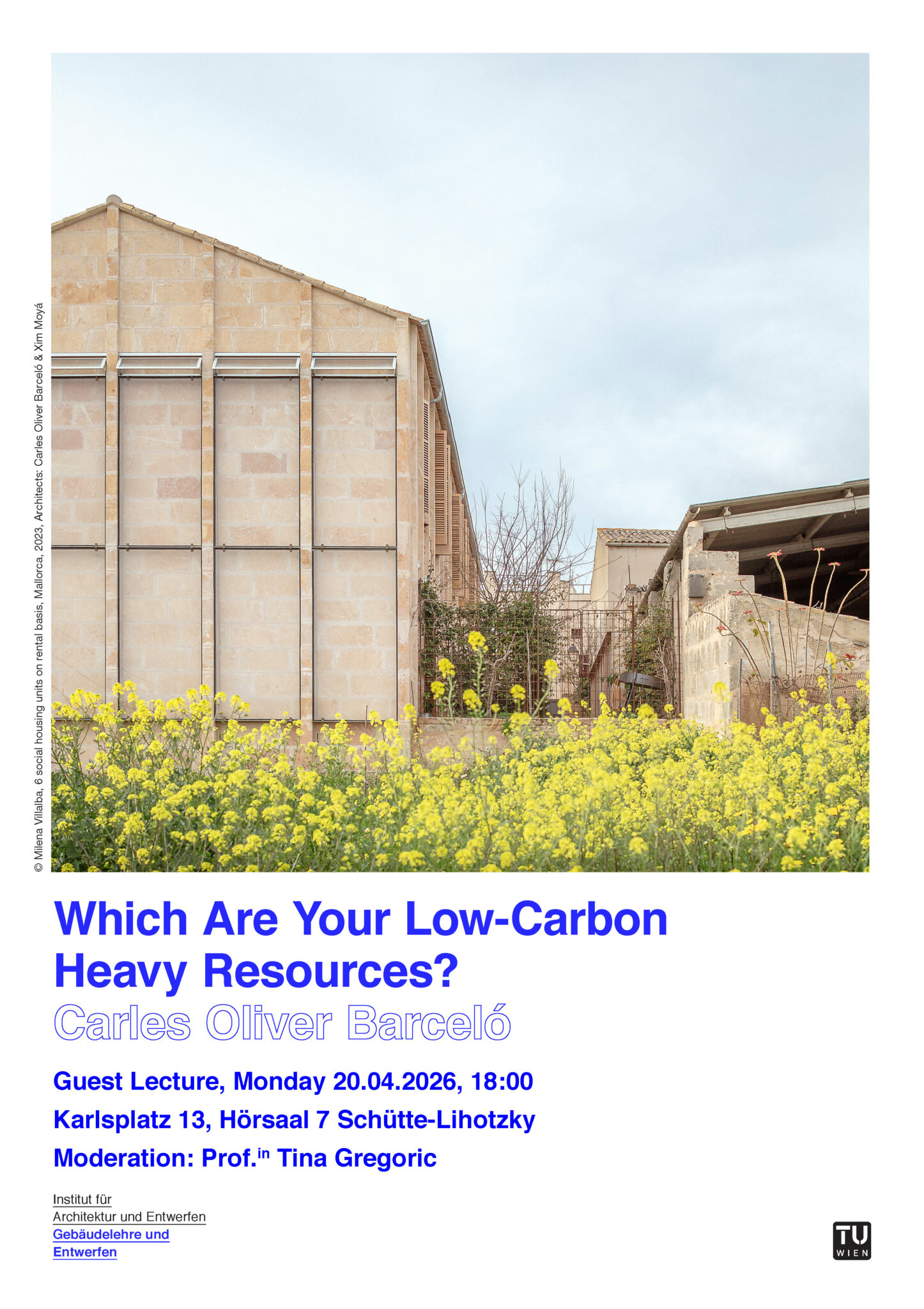
Which Are Your Low-Carbon Heavy Resources?
Carles Oliver Barceló
Montag, 20.04.2026, 18:00, HS 7 Schütte-Lihotzky, TU Wien
Moderation: Prof. Tina Gregoric
Carles Oliver Barceló (Felanitx)
is an architect from the Barcelona School of Architecture (ETSAB) and a master builder out of professional necessity. Since 2009, he has been a member of the Balearic Social Housing Institute (IBAVI), where he directed the climate change adaptation project ‚Life Reusing Posidonia‘ in Formentera, which received the 2021 LIFE Award for Best Environmental Project by the European Commission. From 2019 to 2023, he has been responsible for the IBAVI Technical Department. He has co-authored several award-winning experimental housing projects and refurbishment projects. His work has been widely published and exhibited.
Which Are Your Low-Carbon Heavy Resources?
Over the past century, global CO₂ emissions have risen from 5 gigatons (Gt) to 37 Gt per year, with the construction sector responsible for approximately 37% of these emissions. The Earth and oceans can absorb only 19 Gt of CO₂ annually, which corresponds to the available global carbon budget. And we are spending twice as much as we have. The EU’s binding climate neutrality target for 2050 requires reducing emissions by 55% by 2030 and 92% by 2050. If the carbon budget were to limit the number of dwellings we can build — similar to how the financial budget has done so far — what needs to be done to reduce these values in architectural design? In the Balearic Islands, an example has been developed collectively, consisting of configuring habitability based on the “map of local resources“, which includes many factors such as social resources (knowledge, & buildings traditions, typologies, skills, available labour, etc.), atmospheric resources (sun, rain, wind, etc.), and the local low-carbon materials that constitute the vernacular architecture, cultural heritage, and landscape of each territory, like stone or earth. In addition to materials derived from the optimisation of industrial processes, such as urban mining. Not only have simple compression structures demonstrated greater durability and minimal embodied CO₂ emissions, but they also provide the necessary inertia and mass to withstand extreme heatwaves, particularly in Mediterranean climates. The guest lecture by Carles Oliver Barceló will illustrate how these strategies can contribute to a rethinking of architectural design in response to the global carbon budget.
The Guest Lecture is part of the Design Studio „Mallorca: Social Housing with Local Resources“ (BA 253.O90, MA 253.O91)
Further Information:
https://www.instagram.com/carlesoliverbarcelo